



Melissa Michalik has been in corporate real estate long enough to remember counting cars.
“We’d go out into the parking lot at certain times during the day and count cars to see how many people [were in the building],” she said on our October 21 Bisnow webinar, The State of Office Space Utilization and Optimization. “And that was really ineffective.”
Melissa is Global OPM Operations Leader at JLL, where her team of roughly 800 occupancy planners advises corporate occupiers around the world. Our Head of Customer Success, Enid Maran, bet that somebody out there still counts cars. Melissa didn’t argue.
Most organizations haven’t moved as far from the parking lot as they think. They’ve swapped it for badge swipes, Wi-Fi connection counts, a booking calendar, an occasional walk-through study and a spreadsheet to stitch it all together.
It’s good enough. That’s the problem.
Nobody chooses bad data. They inherit it.
Badge data exists because security needed it. Wi-Fi data exists because IT needed it. Booking data exists because people needed rooms. None of it was built to measure how space is used. But it’s already there, it looks free, and replacing it sounds like a project.
JLL’s 2026 Global Occupancy Planning Benchmark found that 92% of organizations use badge swipes to understand occupancy. Only 7% rate their occupancy data capability as excellent. Nearly everyone uses the tool. Almost no one trusts it.
Occuspace CEO Nic Halverson put it plainly on the webinar:
“Nobody thinks badge data is that accurate or that good, but they kind of default to, well, this is what I have.”
Then teams make lease, consolidation and capital decisions worth millions on that dataset.
We asked the webinar audience why they still rely on badge data alone. The top answer (38%): alternatives seem too expensive or hard to deploy. We asked what stops them from using better space data. The top answer (34%): cost and the business case.
The status quo isn’t winning on accuracy. It’s winning on perceived effort.
The cost of good-enough data never shows up as a line item. It shows up as square feet you keep, build or rebuild without needing them.
Melissa told the story of a client that spent a million dollars rebuilding a space around its badge counts, only to find the office nearly empty. The people swiping in were engineers who badged in early and left for the field. (We told that story in full in Badge Data Isn’t Utilization Data.)
That isn’t an outlier. In Occuspace’s H1 2026 Space Utilization Index, one building logged 701 badge-ins on its busiest day. The most people inside at any one moment: 439. Size that building to badge counts and you plan for 60% more people than were ever there at once. A second building the same week was off by 11%. No correction factor fixes that, because the error changes by building, by day and by team.
Wi-Fi data fails from a different direction. Access points are built to keep devices connected, not to count people. They miss anyone whose phone isn’t on the network, get confused by randomized device addresses, see floors rather than rooms, and lag when the network is busy. Occuspace integrates Wi-Fi access point data, and we still don’t recommend it alone for anything finer than “is this floor generally active?”
Melissa’s test for any occupancy tool is simple: set what it costs against what your space costs. So let’s run it.
Take a 500,000-square-foot portfolio with a fully loaded occupancy cost of $50 per square foot per year. That’s $25 million a year.
Now size that portfolio to badge data that overstates your real peak by 30%. (The building above overstated it by 60%.) You’d carry roughly 115,000 square feet more than your busiest hour requires: about $5.8 million a year, or $58 million across a 10-year lease.
Measuring every room in that portfolio, every minute, costs around 1% of what it costs to occupy the space: roughly $250,000 a year.
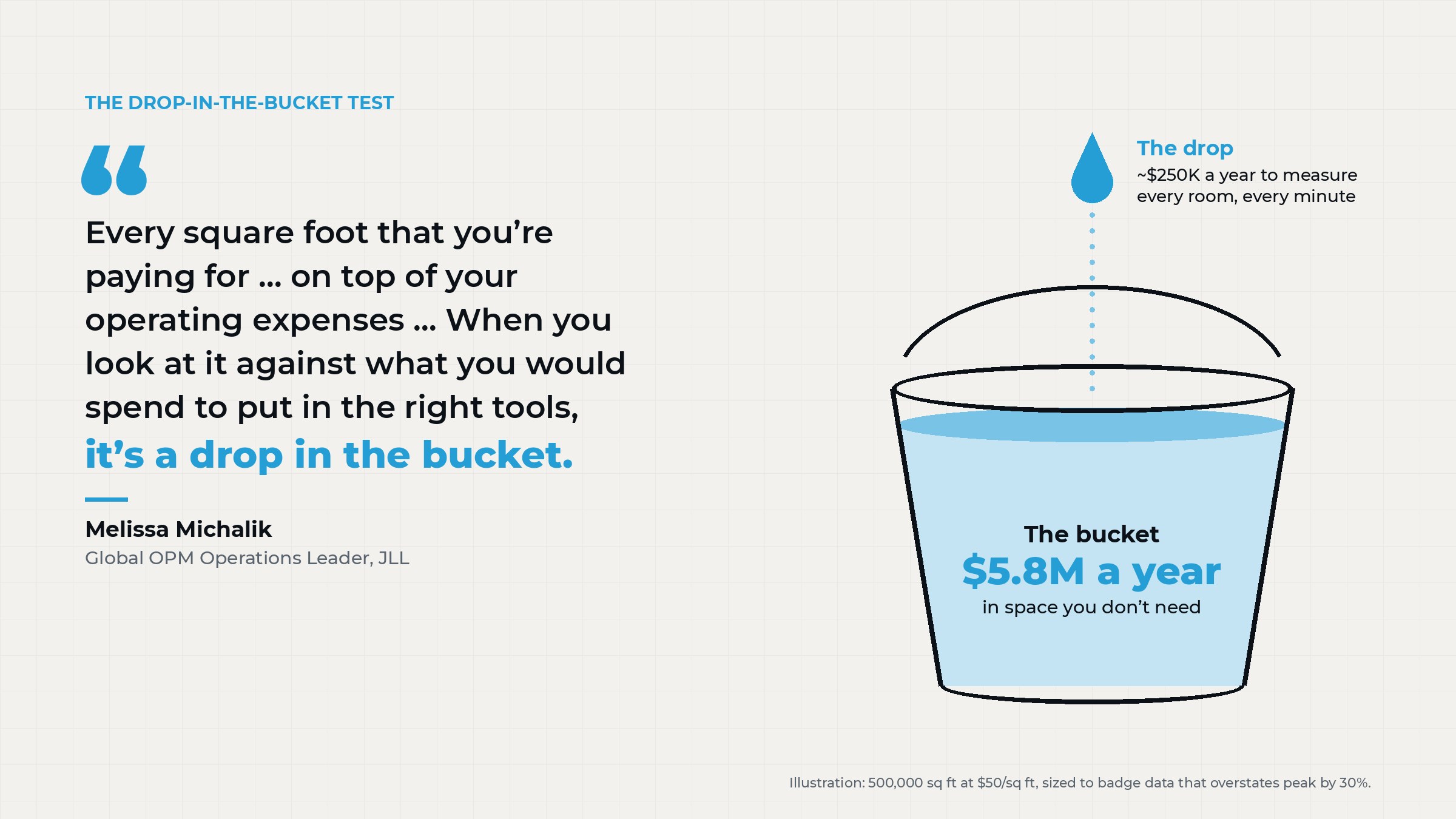
That’s what Melissa meant.
Her own numbers back it up. She has seen clients save up to $18 for every dollar spent on occupancy planning services. When just a quarter of her team tallied the savings they’d found for clients, it came to more than $300 million. That’s square footage alone, before operating costs. Nic added that the space management case “can be a 100 to 1 ROI in some cases.”
“If you do the business case that way, it sells itself.”
Most hesitation about replacing legacy data comes from the last generation of sensors: wiring, construction crews, long IT reviews and six-figure quotes. That’s a fair memory. It’s no longer the reality.
“We’ll need IT involved.” Occuspace sensors plug into a standard outlet and connect over cellular. They never touch your network, so there’s no integration project. As Enid said on the webinar, security review “is usually actually a pretty fast and easy thing to do, since our sensors don’t require any form of IT integration whatsoever.”
“It’s a construction project.” No wiring. No ceiling work. No installers in your space for weeks. Plug it in.
“The ROI won’t beat the effort.” See the math above. And the same data pays off more than one way. A Bay Area tech company that serves free lunch earns more than 2-to-1 on Occuspace from reduced food waste alone. Each morning its kitchen learns how many people are actually in the building, and food waste has dropped more than 20%.
“Employees will feel watched.” Occuspace counts people, not identities. No cameras. No personally identifiable information is ever known or collected.
Each objection is reasonable when you’re weighing a big, risky project. None of them describes what it takes to measure your space today.
The case for wall-to-wall, real-time occupancy isn’t one decision. It’s that the same data answers all of them, continuously.
Wall-to-wall matters because decisions don’t stop at the floor you studied. A one-floor pilot or a point-in-time walk-through gives you a snapshot that’s stale by the next reorg. The teams that do this well, Melissa said, don’t pull data only when a big project lands:
“If you don’t monitor the data on a continuous basis, you’re going to scramble.”
Three things make 2027 the year to stop settling.
The market has turned. CBRE’s 2026 Occupier Sentiment Survey found that 66% of occupiers plan to hold or grow their footprint. The decision in front of you is as likely to be an expansion as a cut. Either way, getting it wrong is expensive.
AI is arriving whether your data is ready or not. Leadership is asking CRE and workplace teams to plan with AI. The output can only be as good as the input.
Lease decisions need lead time. If a renewal, consolidation or new headquarters is 12 to 24 months out, measurement needs to start now, so you have a full picture of real use before the decision has a date.
Melissa described planning without real data this way: “It’s like shooting a rabbit in the dark blindfolded.”
Good enough was fine when there was no better option. Now there is one, and it costs a fraction of the space it protects. Every lease, floor plan, lunch order and thermostat setting can rest on what actually happens in your buildings, not on what a door, a router or a spreadsheet suggests.
Start with one building. See your real Tuesday. Then decide what good enough is really costing you.
Book a demo to talk through a one-building pilot, or watch the full Bisnow webinar with JLL.
Sources: Bisnow webinar, “The State of Office Space Utilization and Optimization,” presented by Occuspace with JLL, October 21, 2026; JLL 2026 Global Occupancy Planning Benchmark; Occuspace Space Utilization Index, Corporate Real Estate Edition, H1 2026; CBRE 2026 Occupier Sentiment Survey.



